Posted By Gail Kulp,
Sunday, March 28, 2021
Updated: Thursday, March 25, 2021
Interview with Rapid Media– Winner of the 2020 National Boating Industry Safety Awards
Video Blog
Rapid Media won the 2020 National Boating Industry Safety Awards in the Marine Media Category. Given that the presentation of the award was done virtually at the MRAA’s Dealers Week, we decided to sit down to talk with Scott MacGregor and Cristin Plaice to find out a little more about their award-winning entry and plans for 2021.
Rapid Media represents the Paddlesports Industry and started a public awareness and role modeling campaign to reduce deaths and injuries in paddlesports. The effort is to make paddlers aware of ways to keep them safe on the water and encourage them to adopt these safe behaviors. They are reaching paddlers through their magazines, their paddling film festival and social media and are also working with retailers to explain the safety steps that should be taken.
Posted By Gail Kulp,
Monday, March 22, 2021
Updated: Wednesday, March 3, 2021
What Paperwork Do You Need on Your Boat and How Do You Keep it Dry?
Whether you are out on your boat to relax, fish, or have dinner with your family, an evening on the boat is a time to enjoy. The lights reflecting on the water, the cool breeze in your hair, and a state official kindly requesting to see your documentation. OK ... perhaps the latter experience would not be a special addition to your evening, but it can quickly sink your plans if you don’t have the proper paperwork stored alongside your swimsuits and towels. Unlike these items, you also need your documents to be dry.
To avoid having your long-anticipated boating adventures interrupted by paperwork problems, Sea Tow Foundation has prepared a list of documents to keep on your boat and also provides some tips on how to store them safely.
What documents do you need?
License. Just like anyone driving a car, a captain must have his or her identification, which is usually in the form of a driver’s license, on board at all times. If you get caught without it, your perfect night on the water might be punctuated with a fine.
Boat Documentation.The law requires you to have either a state registration or United States Coast Guard federal documentation for your boat. Every state has a slightly nuanced registration requirement, so be sure to check out the USA Boat Registration to see what your state requires before you head out on the water.
Recreational Licenses and Safety Certificates. Some states require boaters to carry proof of completing a boating safety course. Each state is different, so you might need the certificate on a personal watercraft, but not on a pontoon boat; or you might need it for all boats if you were born on or after a certain date. Check your state’s boating education requirements before you launch your boat. If you are out fishing, or hunting, keeping track of your fishing and hunting licenses will be important as well.
Boat Insurance. Different boats call for different types of boating insurance. Keeping the proof of that insurance on your boat will ensure you are prepared for any unexpected incidents on the water. If you carry additional coverages for your trailer or other equipment, make sure to carry those cards as well.
On-Water Assistance. If you have a membership with Sea Tow for marine assistance, you will want to carry your wallet-size card, or you can access your membership through your phone via the Sea Tow app. Either way, knowing that you can reach someone for help 24/7/365 will give you true peace of mind on the water.
Health Insurance and Medical History. Consider keeping a copy of your personal medical information on your boat as well as a list of medications that you take or any allergies that you have in case of emergencies. You may also want to do the same for any frequent passengers.
How do you keep them dry?
Dry Box. Several waterproof storage containers are available to keep your documents dry and safe. Dry boxes come in every shape, size, and color. One of our favorites is called the SeaSucker Dry Boxand some of their boxes have accessories like horizontal mounts, cup holders, and padding.*
Dry Bag. This is a specially-made waterproof bag that is a great and portable way to keep anything from getting wet. Dry bags are also available in a variety of sizes and colors to suit your needs.Ugo offers a 100% waterproof dry bag and a smartphone case that even floats.*
Storage Zipper Bag. This should be the option of last resort as these bags can be easily ripped or get a hole in them. If this is the only option available to you on your boat, consider using multiple bags with each one sealed inside of another. Otherwise, these bags can provide a great additional level of coverage for frequently-referenced documentation being stored in a larger dry box or dry bag. This allows you to reach in and take out the document your need without getting it wet or disturbing anything else.
*Sea Tow members can get a discount on both SeaSucker Dry Boxes and Ugo Dry Bags as part of the Sea Tow Savings Club. You’ll need to be logged in as a member to receive the discounts.
Keeping your documents safe and dry on the water is important, and there are so many ways to ensure that this happens. What do you use to hold your documents safely on your vessel?
If you found this article helpful or entertaining, please consider a
donation to the Sea Tow Foundation today to help us continue our efforts
to educate boaters and keep them safe on the water. You can donate
securely online at www.boatingsafety.com/donatetoday or by clicking on the DONATE tab at the top of the page.
Posted By Gail Kulp,
Thursday, March 18, 2021
Updated: Monday, October 23, 2023
Tow Bee Boating Safety Tip: Wear a Personal Locator Beacon (PLB)
PLBs are portable units you can use wear that emit a signal that rescuers can use to find you should you need to be rescued on the water. These beacons can only be activated manually and operate exclusively on 406 MHz.
Similar devices are called EPIRBs which stands for Emergency Position Indicating Radio Beacon and they also have a built-in, low-power homing beacon similar to the PLB. However, an EPIRB is much larger and attaches to a boat, not to a person, and the signal is often automatically sent in an emergency.
In both devices, the emergency signal rescue forces to find the distress beacon through the satellite system which provides the necessary position information.
Posted By Gail Kulp,
Sunday, March 14, 2021
Updated: Thursday, February 25, 2021
Interview with Sea Ray Boats– Winner of the 2020 National Boating Industry Safety Awards
Video Blog
Sea Ray Boats won the 2020 National Boating Industry Safety Awards in the Top Powerboat Manufacturing Category. Given that the presentation of the award was done virtually at the MRAA’s Dealers Week, we decided to sit down to talk with Sara Fahy to find out a little more about their award-winning entry and plans for 2021.
Sea Ray started a “Moments that Matter” campaign for their customers related to the COVID-19 Pandemic that included emails and social media posts to ensure that they knew how to boat safely on the water.
You can find out more about Sea Ray and all of their boats at www.searay.com.
Posted By Gail Kulp,
Monday, March 8, 2021
Updated: Thursday, February 25, 2021
Interview with Freedom Boat Club – Winner of the 2020 National Boating Industry Safety Awards
Video Blog
Freedom Boat Club won the 2020 National Boating Industry Safety Awards in the Marketing & Outreach Category. As the presentation of the award was done virtually at the MRAA’s Dealers Week, we decided to sit down to talk with Nick Gosselin and Nic Thomas to find out a little more about their award-winning entry and plans for 2021.
The Freedom Boat Club’s “Boat Safe Have Fun” initiative includes three levels of training and education for members that are completely free and unlimited to make sure they can have a safe and fun time on the water and be comfortable behind the helm.
Freedom Boat Club also received a special Sober Skipper Award in 2019 for its adoption of the Sober Skipper Campaign at all of their 250+ locations.
You can find out more about Freedom Boat Club and their locations at www.freedomboatclub.com
Check out their video interview below.
Freedom Boat Club Venice Laguna dockstaff team showing off the Award.
Pictured from left to right are Pete B., Maribeth P. and Glenn V.
Posted By Gail Kulp,
Thursday, March 4, 2021
Updated: Monday, March 1, 2021
Sea Tow Foundation’s DIY Craft Time: Life Jacket Fabric Wreath
Spring is here and it is time to check your life jackets to make sure they are in good shape for the boating season. We’ve talked about how to inspect your life jackets and even how to donate your kid’s outgrown life jackets, but we haven’t talked about what to do with them when they are not in good shape and need to be discarded.
In this month’s craft project, we’ll be making a life jacket fabric wreath for your door or wall using damaged life jackets that can no longer be used for keeping you safe on the water. And, as the spring season and holidays are upon us, we can think of this as a fun spring wreath!
Materials to Make Life Jacket Fabric Wreath:
Damaged life jackets
Foam craft ring
Ruler
Sharp scissors
Tacky glue
Plastic plate
Knitting needle
Paper to protect table
Wooden Craft Sign (optional)
Other fabric scraps in coordinating colors (optional if life jackets don’t produce enough fabric)
Directions for How to Make the Life Jacket Fabric Wreath :
Remove the fabric from the life jackets using scissors. Depending on the size of the life jacket and the amount of fabric, you may want to have other fabric scraps in other colors. Multiple colors are better than a single color for this wreath design. Save the straps for hanging the wreath at the end. Also, if the foam is in good shape, save that for a future craft project.
Cut all of the fabric into approximate 2-inch squares using the ruler and scissors. You can also use a cutting board and rotary cutter if you are a frequent fabric crafter.
Place protective paper on the table and arrange the craft ring on top. Pour the glue into the plastic plate and place nearby along with your piles of fabric pieces.
Take a piece of fabric and wrap it around the end of the knitting needle. Dip the end into the glue and then poke the glue-covered fabric into the foam ring and remove the needle.
Repeat step 4 all along the wreath covering the front and sides by alternating colors of the fabrics. Once finished, allow the glue to dry overnight. The glue will dry clear.
Use one of the life jacket straps to wrap around the top for the wreath to hang.
Add a wooden craft sign to the wreath using pins, if desired.
Enjoy the wreath and remember the good times you had in those life jackets!
Congratulations on making a Nautical Wreath! Share your creations with us on Facebook and Instagram by tagging @SeaTowFoundation and using the #DIYNauticalCraftTime
If you found this article helpful or entertaining, please consider a
donation to the Sea Tow Foundation today to help us continue our efforts
to educate boaters and keep them safe on the water. You can donate
securely online at www.boatingsafety.com/donatetoday or by clicking on the DONATE tab at the top of the page.
The Sea Tow Foundation has created monthly nautical crafts to help bring those boating memories home. These crafts are easy for anyone to make and require limited tools and materials. In fact, all of the tools and materials are available at online retailers, or at a local craft store if you don’t already have the items lying around your house. Younger children may need the help of an adult for some portions of the craft project, but they can help with most of the personalization of the crafts. And many of these crafts make great homemade gifts or home décor.
Posted By Gail Kulp,
Sunday, February 28, 2021
Updated: Thursday, February 25, 2021
Interview with FELL Marine – Winner of the 2020 National Boating Industry Safety Awards
Video Blog
FELL Marine won the 2020 National Boating Industry Safety Awards in the Gear and Equipment Manufacturing Category. Given that the presentation of the award was done virtually at the MRAA’s Dealers Week, we decided to sit down to talk with Paul Petani to find out a little more about their award-winning entry and plans for 2021.
FELL Marine developed a wireless engine cut-off device to replace the standard lanyard found on boats. Fell Marine worked on education initiatives to explain to boaters why an engine cut-off device is needed and why it should be used. Video content was developed along with many user manuals and guides, and they also worked with partners and ambassadors to help get the safety message out.
You can find out more about FELL Marine and their products at www.fellmarine.com
Check out their video interview below.
FELL Marine CTO Frederik Erickson and CEO Christian Frost Show off the award at their Norwegian offices.
Posted By Gail Kulp,
Tuesday, February 23, 2021
Updated: Monday, February 22, 2021
Video Blog
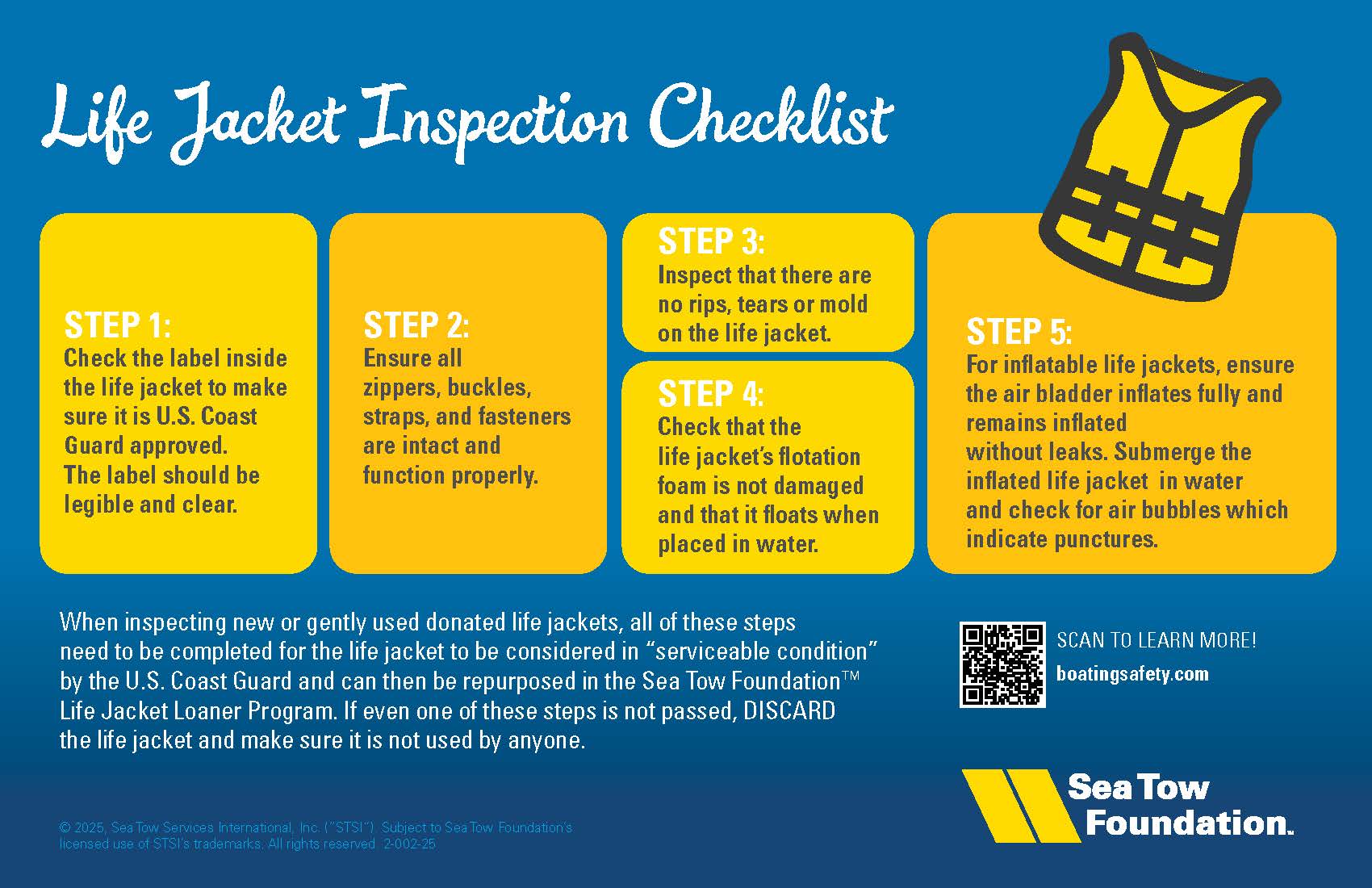
The Sea Tow FoundationTM accepts donations of new and gently used life jackets in our Life Jacket Drive Program. Before adding the donated life jackets to the life jacket loaner stands, they go through a 5-point inspection using a checklist to ensure that they are safe and ready to be used.
The following video walks you through the checklist and shows what to look for when inspecting a life jacket and how to know if you find something wrong with a life jacket. Click here to download the checklist.
If your life jacket does not meet even one of the items on the checklist, you should discard the life jacket and ensure that it is not going to be used by anyone. This can be done by cutting it into pieces before putting it in the trash. And, the Sea Tow Foundation also reused the discarded life jackets and repurposed them into a craft project in one of our craft blogs.
If you found this article helpful or entertaining, please consider a
donation to the Sea Tow Foundation today to help us continue our efforts
to educate boaters and keep them safe on the water. You can donate
securely online at www.boatingsafety.com/donatetoday or by clicking on the DONATE tab at the top of the page.
Posted By Michael Wesolowski,
Thursday, February 18, 2021
Updated: Tuesday, January 5, 2021
Tow Bee Boating Safety Tip: Using an Engine Cut Off Switch
An engine cut-off switch does just that – it turns off the engine automatically. It is often called a Kill Switch because it kills the power to the motor.
An engine cut-off switch is important if the boat operator or a passenger unexpectedly falls overboard when the boat is moving. This can happen when hitting a wave, the wake from another boat, taking a sharp turn, running into a submerged object, or from steering failure. The danger comes in worrying about running over the person in the water with the moving propellers which power the engine underwater and can cause injury or death in seconds. An unmanned powerboat that is still running will end up turning in a circle, often known as the Circle of Death, until it runs out of gas or hits something. And an operator that has been thrown overboard and is attempting to swim to reboard the boat could easily be hit as the boat continues to maneuver in an arc.
The engine cut-off switch is now a requirement for all recreational boats measuring 26 feet or less as of 2018. A copy of this law can be found here.
Engine cut-off switches can be as simple as the lanyard that comes standard with most boats and fits onto the wrist of the operator. Other models allow for wireless options that can be worn by the operator and the passengers of the boat and are activated when the fob-like device that they wear is no longer inside of the boat.
Cody from Waypoint TV talks about the importance of having and using an engine cut-off switch in this video.
Posted By Gail Kulp,
Friday, February 12, 2021
Updated: Tuesday, February 9, 2021
Looking Back on the Miami International Boat Show
The memory of those beautiful, mid-February days in Miami don’t fade very fast. They remind us of that time of year when members of the Sea Tow Foundation load up crates of life jackets and boating safety material, and then ship them out for the Miami International Boat Show. But that won’t be happening this year.
For the last 33 years, boating enthusiasts from around the globe, have excitedly attended the largest boat show in the United States. However, in an effort to keep everyone safe during the pandemic, show organizers decided to cancel the event this year. While we’re sad that we won’t be teaming up with our Miami friends and volunteers, we realize it’s the best decision.
One thing is for certain though, we have lots of memories from previous years and we’d like totake a moment to reflect back.
The Sea Tow Foundation has attended the show for the last 12 years and we have hosted a Life Jacket Loaner Stand there for the past four.
The docks at the Miami Boat Show are crowded and families often wanted to take test rides on the many boats for sale, but children’s life jackets were not always available, and some would forget to bring their own.Thankfully, the Sea Tow Foundation brought their nationwide Life Jacket Loaner Station program to the show attendees so that life jackets could be provided in all sizes including infant, child, youth and adult..
The faces of children, their parents and individuals from all walks of life also standout as a happy memory. Thousands of people have visited our life jacket loaner stands to borrow life jackets and many more received our information on boating safety. Our goals were being accomplished every day at the show by the sheer number of individuals we were able to influence with a positive message.
The Foundation’s participation in the show has evolved over the years as well.
Last year, we launched our first ever “Life Jacket Selfie Giveaway Contest.” Through a partnership with the boat show organizer, the National Marine Manufacturers Association (NMMA) as well as partnerships with Onyx, FELL Marine, FishGillz, Navionics, Source4 and Formula Boats. As a part of this contest, the Sea Tow Foundation gave away five prize packages, valued at $3,600 each, to the show attendees and boaters watching from home. To be entered to win, participants had to take a selfie while wearing a life jacket at the show, post the photo to social media with the hashtag #LifeJackets4theWin, and tag the Sea Tow Foundation. As a result, social media was filled with posts from individuals eager to enter the contest, while our message of wearing life jackets reached thousands.
The Sea Tow Foundation plans to continue the tradition of ensuring boating can be safe AND fun next February at the Miami International Boat Show. In the meantime, don’t forget to wear your life jacket on the water. You can borrow one for free from the Sea Tow Foundation’s nationwide network of life jacket loaner stations or you can purchase one just for you – either way, the best life jacket is the one that you will wear.
Have you attended the Miami Boat Show in the past and visited our Foundation’s booth? Share with us your experience in the comments below.
 Blog Home
 All Blogs