Boating Safety News
Blog Home All Blogs

Visiting a boating museum can be a fun winter activity

Posted By Gail Kulp, Wednesday, January 15, 2020

Visiting a boating museum can be a fun winter activity

Winter in the northern states can be a tough time of year for boaters. With the snow, ice, and freezing temperatures, it is not ideal to spend time on a boat, but that doesn’t mean that all boating activities have to end. And, even in a warmer weather state, a bad weather day can still ruin plans for a boating trip. On days like that, take a trip to a local boating museum near you!

The Sea Tow Foundation staff had the chance to visit the Finger Lakes Boating Museum this winter. Located in Hammondsport, NY just a couple of hours from Buffalo, Rochester or Syracuse, this museum focuses on the education and preservation of the boating activities and boat building heritage of the Finger Lakes region.

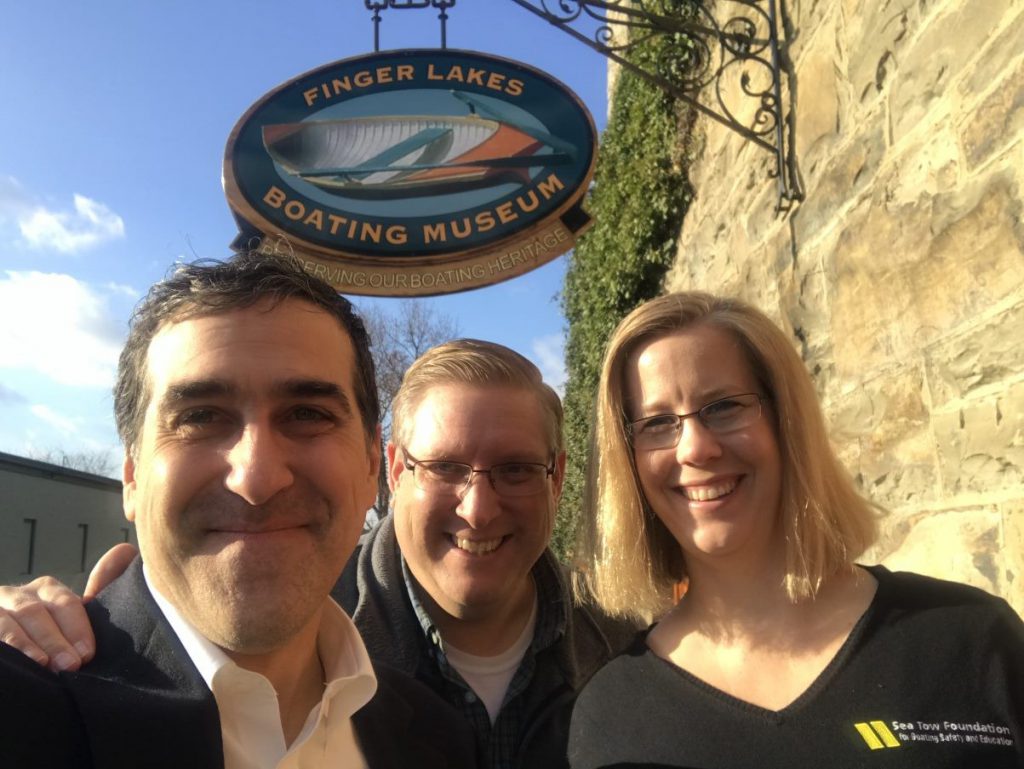
Sea Tow Foundation's Michael Wesolowski and Gail Kulp met with Andrew Tompkins at the Finger Lakes Boating Museum.

The Finger Lakes Boating Museum has over 200 boats on display representing over 40 commercial builders who built boats in the region within the last century. The museum’s campus is the site of the former Taylor Wine Company and includes 19 buildings across 14 acres. While the museum exhibits currently occupy the main building, plans are underway to renovate and move into additional buildings over the coming years to expand the boats on display.

Andrew Tompkins, Executive Director, provided the Sea Tow Foundation with a personal tour and showed off just some of the hundreds of canoes, rowboats, inboards, runabouts and sailboats on display as well as the enormous mural on display downstairs. Andrew noted, “The Finger Lakes Boating Museum sees over 5,000 visitors each year from around the country and we also host a number of school field trips as well.”

So if being on the water is not an option because of the weather, look into visiting a local boating museum like the Sea Tow Foundation staff did this winter. You’re guaranteed to have a good time and you may even learn something!

 Attached Thumbnails:

Tags:  Behind the Scenes  Partner Stories  Weather  Winter 

PermalinkComments (0)
 

Sea Tow Foundation Blog: 5 Reasons to Take a Boating Safety Class this Winter

Posted By Gail Kulp, Saturday, January 4, 2020
Updated: Tuesday, January 28, 2020

Sea Tow Foundation Blog: 5 Reasons to Take a Boating Safety Class this Winter

As the days start to get longer and the calendar creeps closer to spring, the preparations for the spring boating season aren’t far away. These preparations include checking your boat from bow to stern, purchasing new equipment and scheduling your slip at the marina.

You should also add taking a boating safety course to your list as well. Whether you’re a seasoned boater or looking to take one out for the first time, there’s plenty of reasons why you should take a boating safety course prior to spring boating season. Below are five reasons you should enroll in one today:

  1. In many places, it’s the law – A number of states now require that boat operators complete and pass a boating safety course as well. To find out if your state is on this list, you can search for “Boating Agency” and include your state’s name to find their official website. You’ll also be able to find any requirements for taking a boating safety course for a specific type or size of boat or for a specific age of the operator.
  2. Stay up-to-date on new regulations – Many states make changes to boating laws and regulations which take effect on January 1st and a boating safety course will make sure that you know everything you can about being a safe boater including the legal requirements before inviting friends and family out on your boat in a few months when it warms up again.
  3. Learn something new – Just because you’ve been boating all your life doesn’t mean you can’t learn something new! There are courses out there for boaters of all levels, from the basic classes directed at those who have never been on a boat, to more advanced topics aimed at even the most experienced captains. No matter your age or experience level, there’s surely something out there for you to learn!
  4. Help educate a young boater – If you have a son, daughter, nephew, niece, grandchild or any other young one you’d like to pass along your love of boating to, there’s no better place to start than by enrolling them in a boating safety course! Here, they’ll get the hands-on knowledge that will prepare them for a lifetime of boating. To strengthen that bond, you can even take the course with them!
  5. Save on insurance – As an added incentive to get this boating safety training, boating insurance companies regularly offer discounts to boaters who successfully complete an approved boating safety course. Check with your insurance company for a list of courses. Plus, you may learn a thing or two along the way!

Classroom courses are frequently offered in the evenings or on weekends by your state boating agency, the U.S. Coast Guard Auxiliary, America’s Boating Club and many private companies as well. You can also find a list of online boating safety courses that are available on the U.S. Coast Guard’s website. Regardless of how the course is presented, the test will include questions on life jackets, fire safety, anchoring procedures, the Navigation Rules, emergency situations, and state-specific information that boaters should know to be safe on the water in their state.

What’s the best piece of advice you learned in a boating safety class? Share your favorite tidbits in the comments below!


Tags:  2019-20  Americas Boating Club  US Coast Guard  US Coast Guard Auxiliary  Website  Winter 

PermalinkComments (0)
 

Be Sure to Wear Your Life Jacket This Winter and Fall

Posted By Gail Kulp, Friday, November 2, 2018
Updated: Tuesday, February 25, 2020

Did you know that your chances of dying from going overboard are five times greater in winter months than in the summer? If you were to become immersed in cold water for even a short period of time, manual dexterity will be lost within 10 minutes. This will impeded your ability to swim or put on a life jacket, which could lead to drowning long before hypothermia even begins to set in. For that reason, the Sea Tow Foundation wants to remind boaters to always wear their life jackets once the temperatures begin to drop.

A total of 7 northern states have laws requiring life jackets to be worn by boaters during typically cold weather months. Many of these requirements specifically mention that the life jackets must be USCG-approved and mention specfic types of Personal Flotation Devices (PFD) that must be worn. While each state's policy may differ, it is important to follow these laws. 

Connecticut: USCG-approved life jackets must be worn by anyone in a manually propelled vessel from October 1 through May 31 (must be a Type I, II, III, V or V-hybrid PFD).

Maine: All boaters canoeing or kayaking on the Saco River between Hiram Dam and the Atlantic Ocean between January 1 and June 1 must wear a life jacket (Type I, II or III PFD).

Maryland: A person aboard a boat, raft or tube shall wear a USCG-approved life jacket (Type I, II, III or V PFD) at all times while underways on the Upper Potomac River and its tributaries, during the period beginning each November 15 and ending each May 15. 

Massachusetts: All boaters canoeing or kayaking from September 15 - May 15 are requied to wear a USCG-approved life jacket (Type I, II or III PFD).

New York: The mandatory life jacket requirement applies to everyone aboard boats less than 21 feet in length, including rowboats, canoes and kayaks, between November 1 and May 1.

Pennsylvania: Boaters are required to wear USCG-approved life jackets on boats less than 16 feet in length or any cane or kayak during the cold weather months from November 1 through April 30.

West Virginia: A person aboard a boat, raft or tube must wear a USCG-approved life jacket (Type I, II, III or V PFD) at all times while underway on the Shenandoah River within the boundaries of West Virginia during the period beginning each November 15 and ending each May 15.

Even if your state doesn’t have a cold weather life jacket wear requirement, it is a smart and safe idea to wear a life jacket any time the water temperature drops below 60 degrees. It is also important to ensure that the life jacket you are wearing is appropriate for the type of activity that you will be participating in. Life jackets save lives, but only if they are worn.

Tags:  2018-19  Cold Weather  Life Jacket Loaner Program  Life Jacket Wear Policies  States  Winter 

PermalinkComments (0)
 
Join Our Mailing List

Get the latest news, information,
events and more delivered to your
email inbox

Join
On-Water Assistance
SEA TOW

For membership information or help with boat towing and marine assistance

Connect With Us

Sea Tow Foundation
P.O. Box 1325
Southold, NY 11971
www.boatingsafety.com
888-276-7691

©2025, Sea Tow Services International, Inc. ("STSI")
Subject to Sea Tow Foundation's licensed use of STSI's trademarks. All rights reserved.